
Every fall, two different open enrollment periods overlap, and it’s easy to mix them up. Medicare’s open enrollment started October 15. The Health Insurance Marketplace (HealthCare.gov) opens November 1. They have different rules, different deadlines, and they’re for different people. That’s what makes open enrollment for adults over 50 so confusing.
If you’re over 50, one of them probably applies to you, and knowing which one is the first step. This guide explains who each one is for, the key dates, and what to review before you make a choice.
Which open enrollment for adults over 50: applies to you?
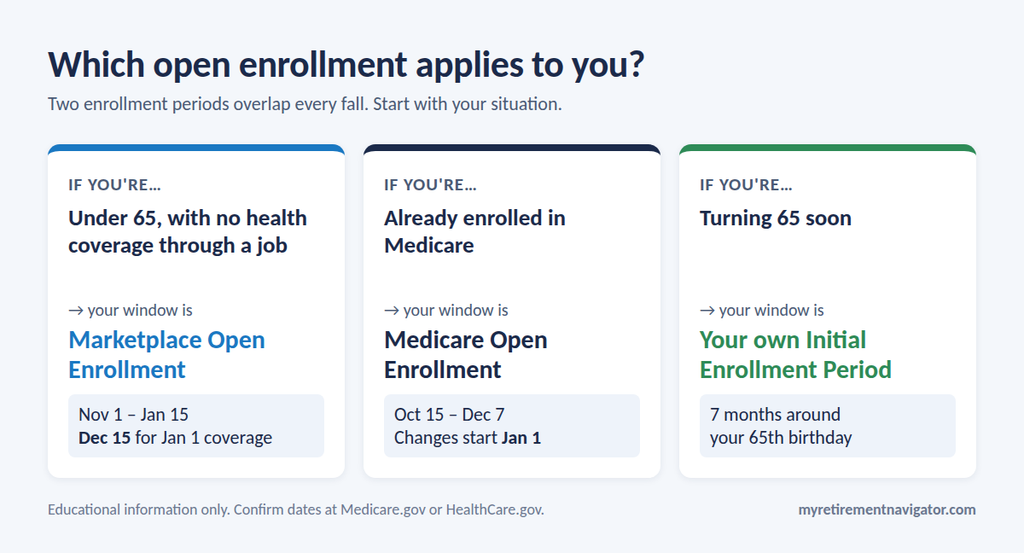
You’re under 65 and don’t have health coverage through a job. This includes many early retirees. The Marketplace open enrollment is yours. It’s how most people buy individual health insurance before Medicare starts.
You’re already on Medicare. Medicare Open Enrollment is yours. It’s your yearly chance to review your coverage and make changes for next year.
You’re turning 65 soon. Your first Medicare sign-up doesn’t happen during fall open enrollment. It happens during your own Initial Enrollment Period, a seven-month window around your 65th birthday. If you’re on a Marketplace plan now, see the section on turning 65 below.
You still have coverage through your job or your spouse’s job. Your employer has its own open enrollment, usually in the fall. Neither of these may apply to you yet, but it’s worth knowing how they work before you retire.
Key dates at a glance
| Medicare Open Enrollment | Marketplace Open Enrollment | |
|---|---|---|
| Who it’s for | People already on Medicare | People under 65 without job-based coverage |
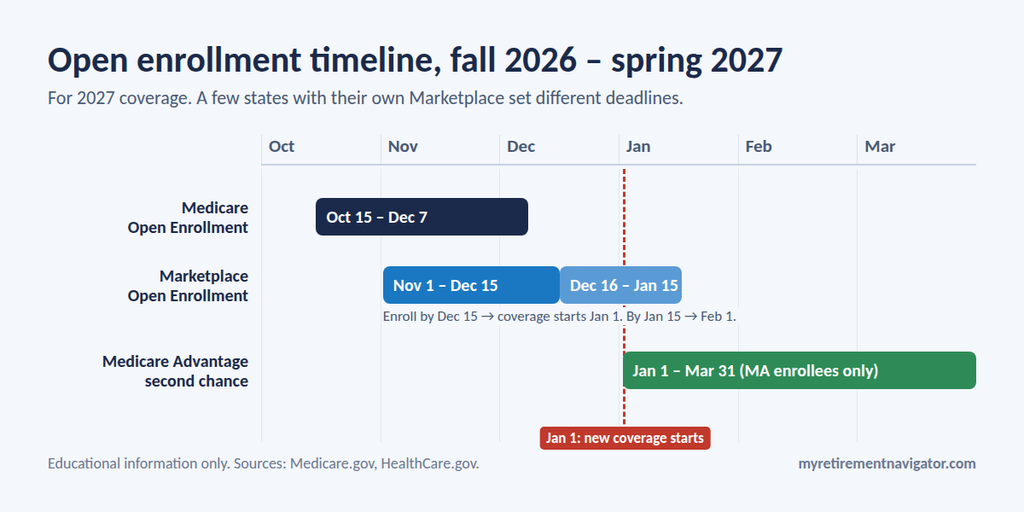
| Dates | October 15 – December 7, 2026 | November 1, 2026 – January 15, 2027 (most states) |
| Coverage starts | January 1, 2027 | January 1 if you enroll by December 15; February 1 if you enroll by January 15 |
| Where to compare | Medicare.gov Plan Finder | HealthCare.gov or your state’s Marketplace |
A few states that run their own Marketplace set different deadlines, so check your state’s site if you don’t use HealthCare.gov.
Medicare Open Enrollment: October 15 – December 7
During Medicare Open Enrollment, you can:
- Switch from Original Medicare to a Medicare Advantage plan, or from Medicare Advantage back to Original Medicare
- Switch from one Medicare Advantage plan to another
- Join, switch, or drop a Medicare drug plan (Part D)
Your plan must receive your request by December 7, and changes take effect January 1.
Do you have to do anything? No. If you’re happy with your coverage, it generally continues into next year. But plans can change their premiums, costs, drug lists, and doctor networks every year, so it’s worth a review even if you plan to stay put. Your plan sends an Annual Notice of Change each fall that summarizes what’s different. Read it before December 7.
What to review:
- Are your doctors and hospitals still in the plan’s network?
- Are all your prescriptions still covered, and at what cost?
- What will you pay in premiums, deductibles, and copay’s next year?
- If you’re in Medicare Advantage, is your plan still offered where you live?
What’s changing for 2027:
- The yearly cap on out-of-pocket costs for covered Part D drugs rises to $2,400, up from $2,100 in 2026.
- The standard Part D deductible rises from $615 to $700.
- Medicare-negotiated prices take effect for 15 more drugs.
- Some Medicare Advantage plans are leaving certain areas, cutting extra benefits such as dental, or raising cost-sharing.
That last point is why reviewing your plan matters this year. If your plan is leaving your area, you’ll get a notice, and you’ll need to choose new coverage.
A caution about Medigap. If you have Original Medicare with a Medicare Supplement (Medigap) policy, fall open enrollment doesn’t give you special rights to change Medigap policies. Outside your one-time, six-month Medigap Open Enrollment Period (which starts when you’re 65 and enrolled in Part B), insurers in most states can use medical underwriting, which means they can charge more or deny a policy based on your health. Think carefully before dropping a Medigap policy to try a Medicare Advantage plan, because you may not be able to get it back on the same terms.
A second chance in January. If you’re in a Medicare Advantage plan, there’s another window from January 1 to March 31. During it, you can switch to a different Medicare Advantage plan, or drop Medicare Advantage and return to Original Medicare (and join a drug plan).
Marketplace Open Enrollment: November 1 – January 15
The Health Insurance Marketplace is where people without job-based coverage can buy individual health insurance. For open enrollment for adults over 50, the Marketplace is most often used to bridge the gap between retiring and becoming eligible for Medicare at 65.
Key deadline: to have coverage starting January 1, you must enroll by December 15. Enroll between December 16 and January 15, and coverage starts February 1.
Already have a Marketplace plan? Log in and review it. If you do nothing, you may be automatically re-enrolled, but premiums, plan options, and the help you qualify for can change from year to year. Update your expected income for next year, since that’s what your savings are based on.
Know that the savings have changed. Extra premium help that started in 2021 expired at the end of 2025, and Congress hasn’t renewed it. That means many people now get less help with monthly premiums than they did a few years ago, and some may no longer qualify at all. If your premium jumped this year, that’s likely why. Use HealthCare.gov’s tools to see what you qualify for based on your expected 2027 income.
Retiring mid-year? You don’t have to wait for open enrollment. Losing job-based coverage, including when you retire, generally qualifies you for a Special Enrollment Period. You typically have 60 days after your coverage ends to enroll in a Marketplace plan, and you can often apply up to 60 days before it ends, so there’s no gap.
Turning 65 while on a Marketplace plan
This is where people most often get tripped up.
- Sign up for Medicare when you’re first eligible. Waiting can mean late enrollment penalties for Part B and Part D that last for as long as you have that coverage.
- Your Marketplace plan won’t end on its own. You have to update your Marketplace application to end it. You can report your Medicare start date up to three months early, so your Marketplace coverage ends the day before Medicare begins.
- Your Marketplace savings stop. Once you have Medicare Part A or a Medicare Advantage plan, you no longer qualify for savings on a Marketplace plan.
The simplest plan: mark your Medicare enrollment window on your calendar, and set a reminder about three months before your Medicare start date to end your Marketplace coverage.
Three examples: how this plays out
These made-up examples show how open enrollment for adults over 50 works in real life. Your situation may differ.
Linda, 62: retired early, on a Marketplace plan. Linda retired in March and signed up for a Marketplace plan through a Special Enrollment Period when her job coverage ended. This fall, during Marketplace open enrollment, she logs in to HealthCare.gov and updates her expected income for 2027. She’ll have less income next year, since she’s living on savings, which can change how much help she gets with premiums. She compares a few plans, checks that her doctors are in network, and makes her choice by December 15, so her 2027 coverage starts January 1 with no gap.
Robert, 70: on a Medicare Advantage plan. Robert’s Annual Notice of Change arrived in late September. It says his plan is reducing its dental benefit and his cardiologist is leaving the network. During Medicare open enrollment, he uses the Medicare.gov Plan Finder to compare plans in his area that include his doctors and his prescriptions, and he books a free appointment with his state’s SHIP counselor to talk it through. He picks a new plan before December 7, and it takes effect January 1. He also considered switching to Original Medicare with a Medigap policy, but learned that, outside his one-time Medigap window, an insurer could look at his health history before selling him a policy. That’s an important factor to weigh before making that kind of switch.
James, 64, and Maria, 62: one turning 65, one not. Both are on a Marketplace plan. James turns 65 in May 2027, so his Medicare sign-up window opens in February, three months before his birthday month. He signs up early so Medicare starts May 1, then updates their Marketplace application to end his Marketplace coverage on April 30. Maria isn’t eligible for Medicare yet, so she stays on the Marketplace plan. They update their application so her savings are recalculated for just her. Two people in one household, two different paths: that’s very common, and it’s why it helps to plan the switch a few months ahead.
Where to get free, unbiased help
- For Medicare: your state’s SHIP (State Health Insurance Assistance Program) offers free, one-on-one counseling from trained volunteers who don’t sell insurance. Find yours at shiphelp.org. You can also call 1-800-MEDICARE.
- For the Marketplace: HealthCare.gov lists trained local assisters who can help you apply and compare plans at no cost.
Be wary of pressure. You’ll likely see a lot of TV ads, mail, and phone calls this season. Nobody can make you switch plans, and you never have to decide on the spot. If a call feels pushy, hang up and compare plans yourself on Medicare.gov or HealthCare.gov, or talk with a SHIP counselor.
Open enrollment for adults over 50: frequently asked questions
When is Medicare open enrollment for 2027 coverage? October 15 through December 7, 2026. Changes take effect January 1, 2027.
When is Marketplace open enrollment for 2027? November 1, 2026 through January 15, 2027 on HealthCare.gov and most states. Enroll by December 15 for coverage starting January 1.
Can I buy a Marketplace plan if I’m on Medicare? Generally, no. If you have Medicare, you don’t need Marketplace coverage, and you can’t get Marketplace savings once you have Part A or a Medicare Advantage plan.
Make health coverage part of your plan
Open enrollment for adults over 50 is a good yearly reminder that health coverage is one of the biggest questions in retirement planning, especially if you plan to retire before 65. It’s steps 8 and 10 in our Retirement Planning Checklist, and you’ll find links to Medicare.gov, HealthCare.gov, and SHIP on our Resources page.
Want to see where you stand? Get the free Retirement Readiness Blueprint. Page 10 walks you through your coverage plan, including your Medicare dates and how you’ll handle coverage before 65.
This article is for educational purposes only and isn’t individualized insurance, financial, legal, or tax advice. My Retirement Navigator doesn’t sell insurance or recommend specific plans. Dates and costs can change, so confirm current details at Medicare.gov, HealthCare.gov, or with a SHIP counselor before making decisions.